Three Motor Control Modes
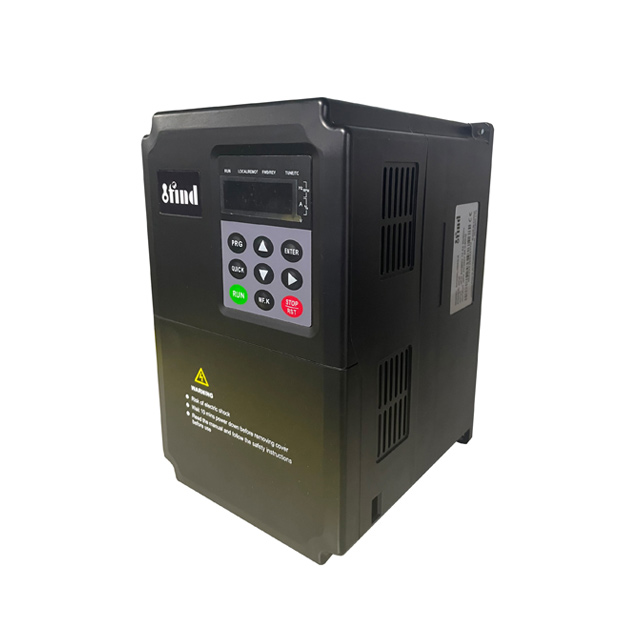
The IFIND SD300 is a general-purpose vector frequency inverter for speed, torque and process control in industrial motor systems. It combines three control modes to accommodate different load characteristics and operating requirements.
Sensorless Vector Control
Sensorless vector control, or SVC, estimates motor speed and magnetic conditions without requiring a shaft encoder. It provides stronger low-speed torque and better response to changing loads than conventional V/F control.
SVC can be considered for applications that require:
Loaded starting
Stable low-speed operation
Wider speed adjustment
Faster response to load changes
Controlled acceleration and deceleration
Operation without encoder feedback
Correct motor nameplate data and motor identification are important for obtaining the expected sensorless vector performance.
V/F Control
V/F control adjusts motor voltage according to output frequency. It provides straightforward speed control for variable-torque loads and applications that do not require high-precision torque regulation.
Typical V/F applications include:
When one inverter operates several motors, each motor normally requires separate overload protection.
Torque Control
Torque control regulates motor output according to the selected torque reference. It can support machinery where load response, pulling force or torque limitation is more important than maintaining one fixed speed.
The correct control mode depends on the motor, driven equipment, minimum speed, starting load and required process accuracy.
High Starting Torque
Under sensorless vector control, the SD300 provides 150% of rated torque at 0.5Hz. This allows an appropriately matched motor to develop substantial torque at low frequency without using encoder feedback.
Low-speed starting performance can benefit:
Loaded conveyors
Air compressors
Textile machinery
Mixers and processing equipment
Pumps starting against pressure
Machinery with frequent load changes
Actual starting performance also depends on motor current, load inertia, mechanical condition and parameter setup.
Increasing torque boost or current limits without checking the motor and load may cause overheating or repeated overcurrent trips. Commissioning should begin with the correct motor data rather than excessively high compensation settings.
Dynamic Speed Response
The SD300 adjusts output frequency, voltage and current as the motor accelerates, decelerates or experiences a change in load.
Its published functions include:
Rapid acceleration and deceleration response
Automatic current limiting
Automatic voltage limiting
Rotation-speed tracking restart
Over-torque detection
Jump-frequency control
Instantaneous power-loss ride-through
Multiple maximum-frequency setting sources
Automatic current and voltage limiting help reduce repeated trips during changes in operating conditions. These functions cannot compensate for an incorrectly sized inverter, unsuitable deceleration time or mechanical obstruction.
The maximum operating frequency must remain within the permissible speed of the motor and connected machine.
16-Step PLC and Multi-Speed Control
The built-in simple PLC supports operating sequences of up to 16 steps. Each step can be assigned an operating frequency, direction and running time according to the available parameter functions.
The simple PLC can be used for:
Repetitive speed sequences
Timed process stages
Multi-speed machine cycles
Automatic washing or pumping sequences
Textile-machine speed changes
Basic material-handling processes
Preset multi-speed control also allows external digital terminals to select defined operating frequencies.
The built-in simple PLC is intended for basic drive sequences. It does not replace a full industrial PLC when the machine requires complex interlocking, safety logic, motion coordination, data processing or control of several devices.
PID and Sleep/Wake Control
The SD300 includes PID control for processes that use a feedback signal to regulate motor speed automatically.
A typical PID system includes:
A target value
A pressure, flow, temperature or other sensor
An analog feedback signal
The SD300 PID calculation
Motor-speed adjustment
Constant-Pressure Water Systems
A pressure sensor can provide feedback to the inverter. The SD300 adjusts pump speed as water demand changes, helping the system maintain the configured pressure target.
Fan and Airflow Control
PID control can regulate fan speed using pressure, airflow, temperature or another suitable process signal.
Air Compressor Control
The inverter can adjust compressor-motor speed according to a pressure reference. The original compressor controller must continue to manage unloading, lubrication, cooling and safety functions.
Sleep and Wake Operation
The sleep/wake delay function can stop or slow the motor when process demand remains low, then restart it when the feedback signal reaches the configured wake condition.
Sleep frequency, wake threshold and delay time must be set carefully to avoid frequent cycling.
DC and Resistor Braking
DC Braking
The SD300 supports DC braking during starting and stopping.
Starting DC braking may be used to stop residual motor rotation before a new run command is accepted. Stopping DC braking applies DC current to help bring the motor to rest at the end of deceleration.
DC braking parameters must consider:
DC braking is not a mechanical holding brake and should not be used to hold a suspended load.
Braking Resistor Support
Published product information states that SD300 versions from 0.75kW to 15kW include an internal braking unit, allowing a suitable braking resistor to be connected for applications requiring faster stopping.
A braking resistor dissipates regenerative energy produced during deceleration. The resistor resistance, power rating and duty cycle must be selected for the actual machine.
A braking resistor may be required for:
Short deceleration times
High-inertia machinery
Frequent stopping
Overhauling loads
Rapid reversing cycles
The resistor must be installed with adequate ventilation and protection from accidental contact.
Built-In DC Reactor
The published configuration states that SD300 inverters from 18.5kW to 90kW include a DC reactor.
A DC reactor can improve the drive’s input-current conditions by reducing current peaks and helping limit harmonic distortion. It can also support operation where the incoming supply is relatively stiff or subject to electrical disturbance.
The reactor does not replace:
Confirm the reactor configuration for the exact voltage and power model before ordering.
Flexible Commands and Programmable I/O
The SD300 supports several frequency-setting methods:
Programmable input and output terminals allow the inverter to exchange operating commands and status signals with external switches, sensors, relays, PLCs and other automation equipment.
Typical terminal functions may include:
The exact terminal quantity, electrical ratings and available assignments should be checked in the SD300 manual.
Control cables should be separated from motor and power cables where practical. Shielding, grounding and common-terminal wiring must follow the selected signal type.
Resonance Avoidance and Speed Tracking
Jump-Frequency Control
Some machines experience increased vibration at specific motor speeds. Jump-frequency control allows selected frequency bands to be avoided during continuous operation.
This function can help reduce operation at a known mechanical resonance, but it does not correct misalignment, bearing damage, imbalance or an unsuitable mechanical structure.
Speed-Tracking Restart
Speed-tracking restart allows the inverter to identify the approximate speed of a rotating motor before resuming control.
This function is useful for:
Fans with long coast-down times
Pumps affected by reverse flow
Machinery restarted after a short interruption
Loads that continue rotating after a stop command
Motor direction, load condition and restart permissions must be considered before enabling automatic restart.
Bidirectional Shift Key
The operating panel includes a bidirectional shift key for viewing real-time operating parameters. This can simplify commissioning and fault observation without changing the active control command.
Drive Protection
The SD300 includes protection functions for common electrical and operating faults:
Automatic current and voltage limiting help reduce frequent overcurrent and overvoltage faults during operation.
Protection settings must match the connected motor and application. The inverter’s electronic protection does not replace upstream short-circuit protection, motor thermal devices, emergency-stop circuits or machine safety controls.
A trip should not be reset repeatedly before its cause is identified. Check the fault code, motor current, load condition, acceleration or deceleration time, cooling and wiring.
Power-Loss Response
The product information lists an instantaneous power-failure non-stop function. During a short reduction or interruption in the input supply, the inverter may use the remaining DC-bus energy and energy returned by the rotating load to maintain controlled operation.
The available ride-through time depends on:
Input-voltage reduction
Motor speed
Load inertia
Motor load
DC-bus voltage
Parameter settings
This function does not provide uninterrupted operation during a prolonged outage and does not replace a UPS or backup power system.
Automatic restart after a power interruption should only be enabled when an unexpected motor restart cannot create a hazard.
Industrial Applications
Water Pumps
V/F or sensorless vector control can regulate pump speed according to pressure, flow or process demand. PID and sleep/wake functions support constant-pressure and intermittent-demand systems.
The pump’s minimum speed, cooling requirement and operating curve must be considered before reducing frequency.
Fans and Blowers
Fan speed can be adjusted according to airflow, pressure or temperature demand. Speed tracking supports controlled restart when the fan is still rotating, while jump-frequency settings can avoid known resonant speeds.
Air Compressors
Sensorless vector control, torque management and PID adjustment can support compressor systems with varying air demand. The compressor’s original protection, unloading and lubrication controls must remain functional.
Textile Machinery
The 16-step PLC, multi-speed control, torque functions and programmable terminals can support textile equipment requiring repeatable speed changes or controlled load response.
Other Industrial Machinery
The SD300 can also be evaluated for conveyors, mixers, processing equipment and machinery that requires programmable speed control.
Final suitability depends on motor type, motor current, load characteristic, operating cycle, braking demand and environmental conditions.
Technical Specifications
Control and Functional Data
Parameter | Published Specification |
Product model | SD300 |
Product type | General-purpose vector frequency inverter |
Control modes | Sensorless vector control, V/F control and torque control |
SVC starting torque | 150% of rated torque at 0.5Hz |
Voltage classes | 220V or 380V |
Simple PLC | Up to 16 operating steps |
Process control | Built-in PID |
Speed control | Multi-speed and multiple frequency-reference methods |
Frequency settings | Digital, analog, PID and communication |
Braking | Starting and stopping DC braking |
Braking unit | Published as built in for 0.75–15kW |
DC reactor | Published as built in for 18.5–90kW |
Terminal functions | Programmable input and output |
Resonance control | Jump-frequency function |
Restart function | Rotation-speed tracking restart |
Additional functions | Sleep/wake delay and over-torque detection |
Panel operation | Bidirectional shift key for real-time parameter viewing |
Protection Functions
Protection | Function |
Overtemperature | Responds when drive temperature exceeds its permitted limit |
Undervoltage | Responds when DC-bus voltage becomes too low |
Overvoltage | Responds when DC-bus voltage becomes too high |
Overload | Responds to excessive load over a defined period |
Overcurrent | Responds to current above the permitted operating level |
Short circuit | Protects against detected output short-circuit conditions |
Automatic current limiting | Limits current during demanding operating conditions |
Automatic voltage limiting | Limits voltage rise during operation or deceleration |
Over-torque detection | Detects torque conditions above the configured threshold |
Electrical ratings, phase configuration, rated output current, dimensions and environmental limits should be selected from the manual or model-specific datasheet.
Installation and Commissioning
The SD300 should be installed in a protected electrical enclosure with suitable clearance, cooling and access for wiring.
Before Installation
Confirm:
Motor Setup
Enter the required motor nameplate data before using sensorless vector or torque control. Complete the applicable motor-identification procedure according to the manual.
Rotating auto-tuning should only be performed when the motor can rotate safely and is disconnected from any load that could create a hazard.
Initial Test
Begin with a low-frequency test and verify:
Load testing should be performed gradually while monitoring motor current, drive temperature and mechanical operation.
Manufacturing and Technical Support
IFIND was established in 2016 in Haiyan, Zhejiang. The company states that its production facility covers approximately 15,000 square metres and employs more than 150 people.
Its manufacturing and service capabilities include:
In-house SMT production
Frequency inverter manufacturing
Product engineering support
OEM services
Application-specific configuration
Technical coordination before shipment
Remote customer assistance
Support through overseas agents
IFIND engineers can review the motor, power supply, load, speed range, braking demand and control requirements before the SD300 configuration is confirmed.
Before Selecting the SD300
Prepare the following information:
Motor type
Motor rated power
Motor rated voltage
Motor rated current
Motor rated frequency and speed
Available supply voltage and phase
Driven machine or equipment
Constant-torque or variable-torque load
Minimum and maximum operating speed
Required starting torque
Acceleration and deceleration time
Starts and stops per hour
Load inertia
Need for a braking resistor
Required PLC or multi-speed sequence
PID sensor and feedback signal
Digital and analog I/O requirements
Communication interface and protocol
Cabinet temperature and ventilation
Installation altitude and motor-cable length
The inverter should be selected according to motor current, load type and overload demand rather than motor power alone.
SD300 Inverter FAQs
What is the difference between SVC and V/F control?
SVC estimates motor conditions to provide stronger low-speed torque and better load response. V/F control provides simpler frequency and voltage regulation and is commonly used for pumps, fans and less demanding loads.
Does sensorless vector control require an encoder?
No. The published SVC starting torque of 150% at 0.5Hz does not require a PG card or motor encoder. Correct motor data and auto-tuning are still necessary.
What can the 16-step simple PLC do?
It can execute a basic sequence of preset speeds, directions and operating times. It is suitable for repetitive drive cycles but does not replace a full PLC for complex machine logic or safety control.
Can the SD300 maintain constant water pressure?
Yes, when it is connected to a compatible pressure sensor and the PID parameters are configured correctly. Pump limits, sensor range and sleep/wake thresholds must also be set.
When is a braking resistor required?
A resistor may be required for fast stopping, high-inertia loads, frequent deceleration or machinery that returns energy to the inverter. Its resistance, power and duty cycle must be calculated for the application.
Does every SD300 include a braking unit?
The product information lists an internal braking unit for 0.75–15kW versions. The exact voltage and model configuration should be confirmed before ordering.
What is the purpose of the built-in DC reactor?
The published 18.5–90kW configuration includes a DC reactor to improve input-current conditions and support system stability. It does not replace normal input protection or EMC measures.
Can the SD300 restart a motor that is already rotating?
The speed-tracking function is intended for this situation. It detects the approximate motor speed before applying the required output, which can reduce current impact during restart.
Can one SD300 operate several motors?
V/F control may be used for multiple motors that run together if the inverter is sized for their combined current. Each motor normally requires separate overload protection. Sensorless vector control is generally intended for one matched motor.
Can the inverter operate a permanent-magnet synchronous motor?
The current page does not clearly confirm synchronous-motor compatibility. Do not connect a PMSM unless the exact SD300 hardware and software version have been verified for that motor.
Can the SD300 be installed outdoors?
The current page does not publish an outdoor protection rating. Install it in a suitable protected cabinet unless the selected model has a confirmed enclosure rating for outdoor use.
Does the power-loss function provide continuous backup power?
No. It is intended for short input interruptions and depends on load and stored DC-bus energy. A prolonged outage requires a separate backup-power solution.
Need an SD300 Inverter Matched to Your Machine?
Send us the motor nameplate, supply voltage, load type, required speed range, starting torque, braking demand and control signals. Our team will review the application and prepare a suitable drive configuration and quotation.
- Motor and load sizing
- Control mode selection
- Braking and reactor review
- Project quotation