You are here: Home / Products / Frequency Inverter / SD3300 High-Performance Vector Frequency Inverter with High-Torque Control
loading
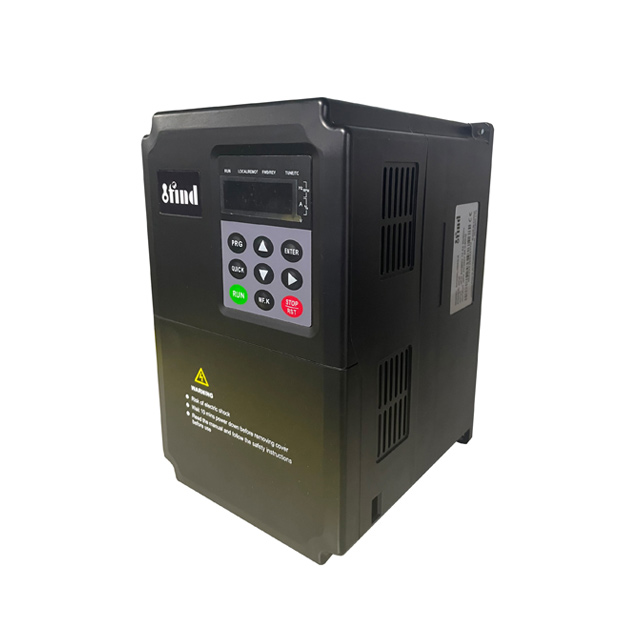
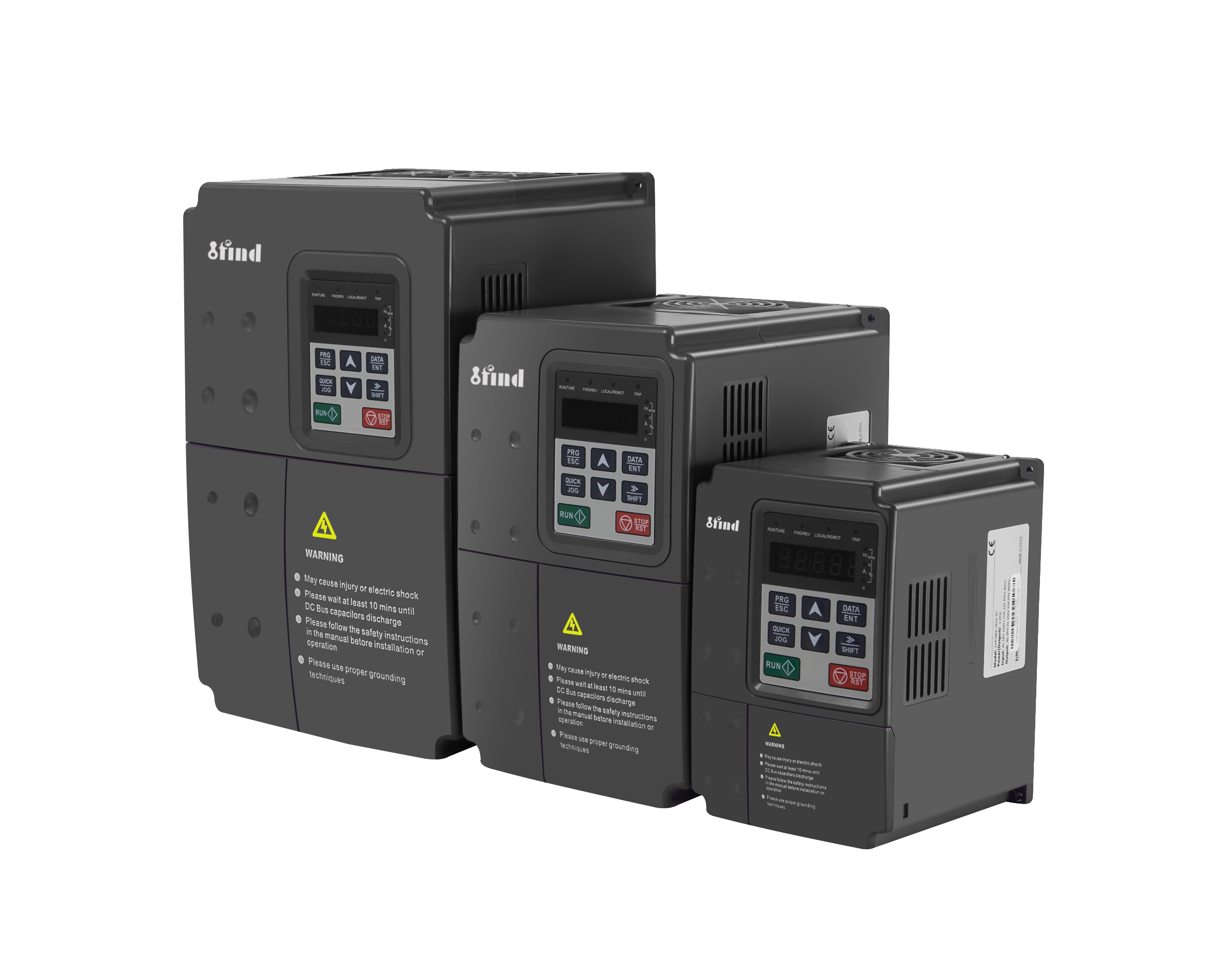
SD3300 High-Performance Vector Frequency Inverter with High-Torque Control
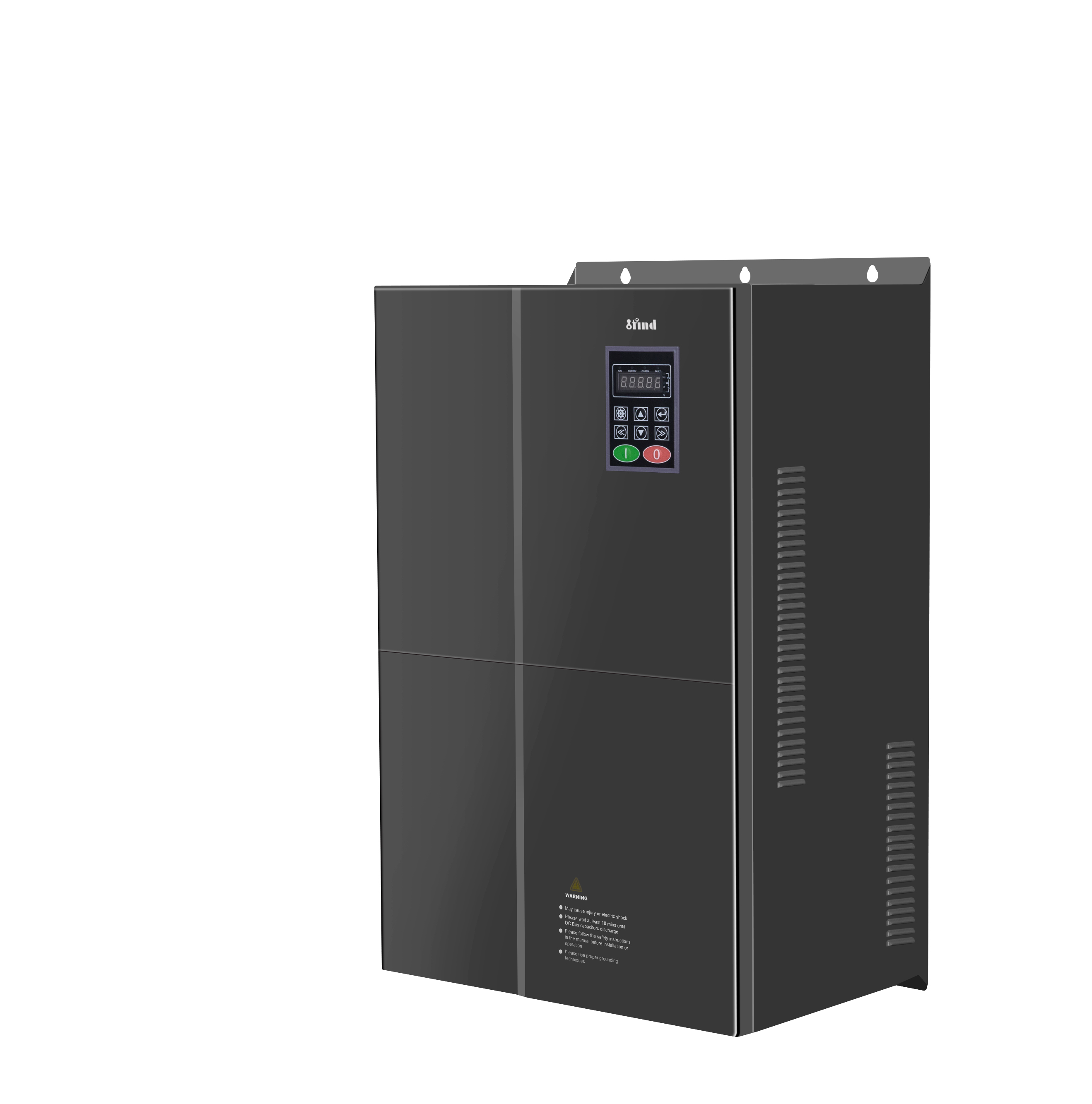
The IFIND SD3300 is a high-performance vector frequency inverter for speed, torque and position-related motor control. It combines sensorless vector control, V/F control, 0.5Hz/150% starting torque, built-in PLC and PID functions, programmable I/O and RS485 communication. Designed for asynchronous motors, it supports pumps, fans, air compressors, textile machinery and other industrial drives.
This High-performance high torque vector power inverter is based on a DSP control system, inside PLC,adopts vector control technology, and is combined with various protection methods. It can be used for asynchronous motors to improve their driving performance. It integrates position, speed, and torque control, supports customer secondary development, meets personalized and industry needs, is flexible in application, and has stable performance.USE V/F AND VECTOR CONTROL MODEL, SUITABLE FOR WATER PUMP ,FAN,AIR COMPRESSOR,TEXTILE MACHINE MORE INDUSTRY APPLICATION.
Main functions of High-performance high torque vector power inverter
1.Three control modes: vector control, V/F control, and higher torque control;
2.Starting torque: without PG vector control: 0.5Hz/150% (SVC);
3.18.5kW-90kW inverter built-in DC reactor to improve input power factor and increaseoverall efficiency and stability;
4.Internal brake unit with every specification 0.75-15kW, so that the braking resister can be connected directlyfor a quick stop;
5.16-steps simple PLC, multi-speed control, and PID control,simple feedback program.
6.Supporting multi-frequency installation methods: digital setup, analog quantity setup, PID setup, and communication setup;
7.Supports starting and stopping DC brake;inside the brake unit as your choice.
8.The input and output terminals may be freely programmed, so users may combine a variety of operating modes as needed;
9.Equipped with jump frequency control which prevents mechanical resonance and makes the system more stable and reliable;
10.Equipped with instantaneous power failure non-outage capability;
11.Equipped with sleep-wake delay installation capability;
12.Equipped with over-torque detection;like inovance inverter.
13.Variety of maximum frequency setting source options;
14.Equipped with a bidirectional shift key , which enables users to use the shift key to view real-time parameters;
15.Rotation speed tracking re-start function: allowing rotating machinery to be started smoothly and without any shocks.
Adopts high performance IGBT from German Infineon, world's biggest power semiconductor supplier---former semiconductor business unit of Siemens.Integrated with 32-bit high performance DSP chip from American Texas Instruments and high speed MCU chip from STMicroelectronics,the simple describe as follow:
1. Integrated with sensor less flux vector control, standard V/F control, 220V or 380V.
2. Rapid dynamic response to quick acceleration/deceleration and rapid braking.
3. Outstanding speed regulation to load fluctuation.
4. Perfect protection such as over temperature, under voltage, over voltage, over load, over current, short circuit protection.
5. Automatic current limiting, voltage limiting to prevent frequent over current/voltage faults in running.
Main advantage of High-performance high torque vector power inverter:
1. Vector and V/F control
2. 0.4-37KW standard built-in brake unit
3. Support common DC bus scheme
4. Support multiple encoding options
5. Integrateed position control
6. Integrated speed control
7. Integrated torque control
8. Closed loop vector control 0HZ 200% torque out
9. Standard RS485 communication control
10.higher torque for the many applications.
The good hardware and famous brand as follow:
IGBT
STARPOWER/ INFINEON/FUJI
FAN
PELKO/NIDEC
CAPACITORS
RUBYCON/JIANGHAI
ELECTRONIC
DELTA
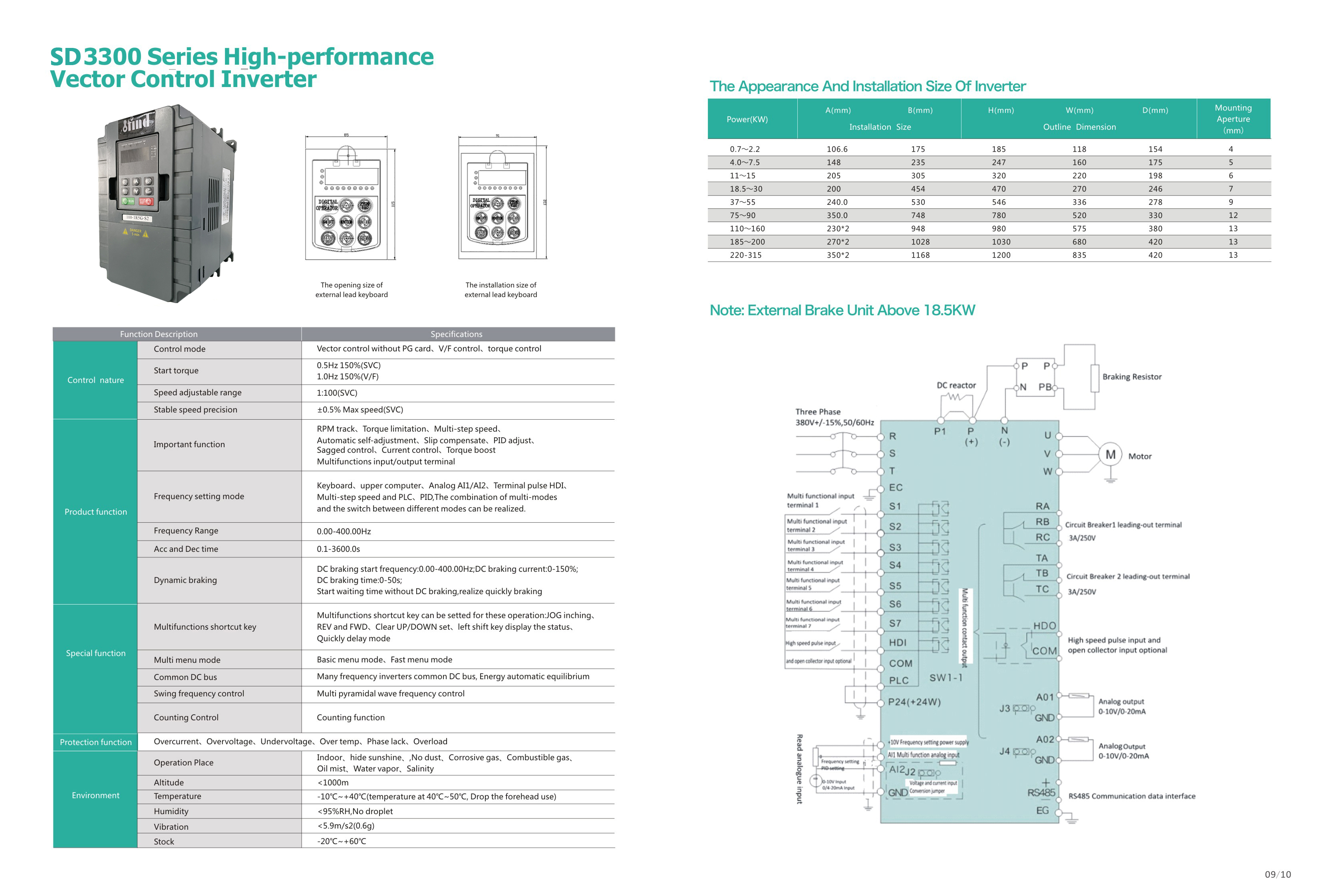
The drawing of High-performance high torque vector power inverter
IFIND High-performance high torque vector power inverter products high-performance, high-quality and high-power density design, high torque of the program and similar with inovance inverter,which has significantly improved in ease of use, maintainability, environmental protection, installation space and design standards, and can further optimize the user experience.Integrated with sensor less flux vector control, standard V/F control, 220V or 380V, Rapid dynamic response to quick acceleration/deceleration and rapid braking, Outstanding speed regulation to load fluctuation, Perfect protection such as over temperature, under voltage, over voltage, over load, over current, short circuit protection, Automatic current limiting, voltage limiting to prevent frequent over current/voltage faults in running.This is the special V/F Control Inversor AC Power Inverters Transformer High Performance Speed Controller VFD ,if u have big interesting with us,we will support and help u extend your market with our brand or your brand,creat the unique brand advantage,not copy anyone else.
Precise Motor Control
The IFIND SD3300 is a high-performance vector frequency inverter developed for speed, torque and process control of three-phase asynchronous motors. Its DSP-based control platform supports demanding industrial loads while providing flexible commissioning options for different machines.
Three principal control modes are available:
Sensorless Vector Control
Sensorless vector control, or SVC, estimates motor speed and magnetic flux without relying on a shaft encoder. It is suitable for applications that need stronger low-speed torque and more stable speed control than standard V/F operation.
V/F Control
V/F control provides straightforward frequency and voltage adjustment for pumps, fans and other applications where the load characteristic does not require high-precision torque regulation.
Torque Control
Torque control allows the drive to regulate motor output according to the process demand. It can be used in machinery where controlled pulling force, load response or torque limitation is important.
The SD3300 also integrates speed and position-related control functions. Encoder options can be configured for applications that require closed-loop feedback.
High Torque at Low Speed
The SD3300 delivers 150% starting torque at 0.5Hz under sensorless vector control. Under V/F control, the listed starting torque is 150% at 1.0Hz.
For encoder-supported closed-loop vector configurations, the product information lists torque output of up to 200% at 0Hz. This makes the series suitable for machinery that must start under load or maintain controlled torque at very low speed.
Low-speed torque performance can help in applications such as:
Loaded conveyor starting
Air compressor acceleration
Textile machinery tension control
Pumps operating under changing pressure
Machinery with frequent speed changes
Equipment requiring controlled low-speed movement
The motor data and vector-control parameters should be commissioned correctly to obtain the expected torque response.
Dynamic Speed Response
Industrial machines often experience sudden changes in load. The SD3300 adjusts output frequency, voltage and current to maintain controlled motor operation during acceleration, deceleration and load variation.
Key dynamic functions include:
Rapid acceleration and deceleration response
Rotation-speed tracking restart
Automatic current limiting
Automatic voltage limiting
Slip compensation
Torque boost
Torque limitation
Jump-frequency control
Over-torque detection
Instantaneous power-loss ride-through function
Rotation-speed tracking allows the inverter to identify the approximate speed of a rotating motor before restarting it. This is useful for fans, pumps and other equipment that may still be rotating when a restart command is issued.
Jump-frequency control can be used to avoid defined operating frequencies where the machine or mechanical structure is prone to resonance.
Built-In Process Functions
Simple PLC and Multi-Step Speed
The integrated simple PLC supports programmed operating sequences without requiring a separate controller for basic applications. Up to 16-step speed control can be configured for processes that operate at several preset speeds.
PID Control
Built-in PID control allows the inverter to adjust motor speed according to a process feedback signal. Typical examples include:
Water-pressure regulation
Air-pressure control
Airflow adjustment
Temperature-related process control
Constant-tension applications
The required sensor and feedback signal must match the inverter’s analog input specifications.
Flexible Frequency Commands
Frequency commands can be provided through:
Digital keypad
Host computer
Analog input AI1 or AI2
High-speed pulse input
Multi-step speed terminals
Simple PLC program
PID control
RS485 communication
Different command methods can be combined or switched according to the machine-control sequence.
Programmable I/O
Programmable input and output terminals allow the inverter to interact with switches, sensors, relays, controllers and other automation devices. Available terminal functions support operating commands, status signals, frequency references and fault outputs.
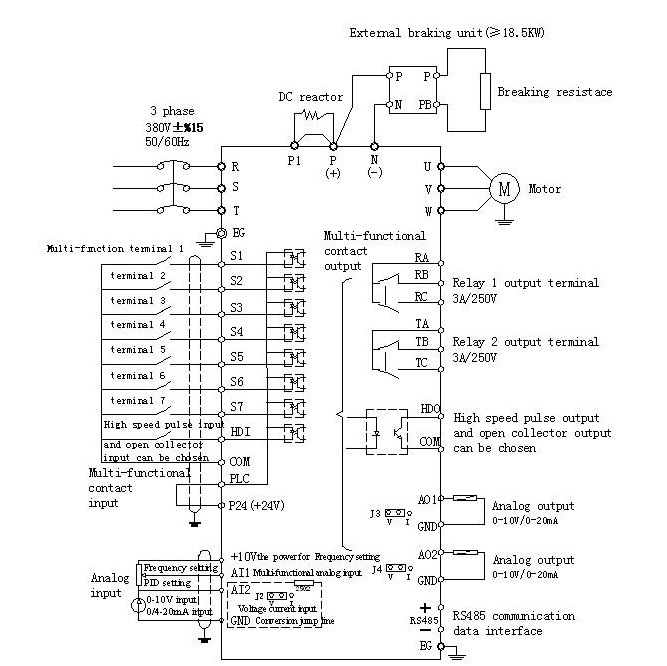
The Drawing of SD3300 High Torque Vector Power Inverter
Braking and DC Bus Options
DC Braking
DC braking can be configured for controlled motor stopping. The published settings include:
DC braking start frequency: 0–400Hz
DC braking current: 0–150%
DC braking time: 0–50 seconds
Actual braking settings must account for motor temperature, machine inertia and stopping frequency.
Braking Resistor
A braking resistor can dissipate regenerative energy generated during rapid deceleration or overhauling-load operation. The required resistor, braking unit and duty cycle depend on the drive power and mechanical load.
Common DC Bus
The SD3300 supports common DC bus configurations for multi-drive systems. Connecting suitable drives to a shared DC bus can allow energy generated by one decelerating motor to be used by another accelerating motor.
Common DC bus systems require coordinated protection, correct drive selection and an engineered electrical design.
Industrial Applications
Water Pumps
With V/F, sensorless vector and PID control, the SD3300 can regulate pump speed according to pressure, flow or process demand. Sleep and wake functions can be configured for systems that operate intermittently.
Fans
Smooth speed control allows airflow to be adjusted without relying entirely on mechanical dampers. Speed tracking is useful when restarting a fan that is still rotating.
Air Compressors
High starting torque, pressure-related PID control and flexible acceleration settings support compressor applications with changing demand. Compressor unloading and safety logic must remain integrated with the original machine-control system.
Textile Machinery
Multi-step speed, torque control, programmable I/O and frequency command options can be used in textile processes requiring coordinated movement, tension control or repeatable speed changes.
Industrial Machinery
The SD3300 can also be evaluated for machinery that requires low-speed torque, programmable speed sequences, controlled braking or communication with an automation controller.
Final suitability depends on the motor type, load characteristic, duty cycle, braking demand and environmental conditions.
Protection and Communication
Drive Protection
The SD3300 provides protection for common electrical and operating faults, including:
Overcurrent
Overvoltage
Undervoltage
Overtemperature
Input or output phase loss
Motor and drive overload
Short circuit
Excessive torque conditions
Automatic current and voltage limiting help reduce repeated trips during acceleration, deceleration or changes in load. Protection parameters should still be set according to the motor nameplate and machine requirements.
RS485 Communication
Standard RS485 communication allows the inverter to exchange commands and operating data with a PLC, HMI or supervisory control system.
Communication can be used for:
Start and stop commands
Frequency setting
Operating-status monitoring
Output-frequency monitoring
Current and voltage monitoring
Fault-code reading
Parameter management
The communication protocol, baud rate, station address and data format must match the connected controller.
Technical Specifications
Control Performance
Parameter
Specification
Motor type
Three-phase asynchronous motor
Control modes
Sensorless vector control, V/F control, torque control
SVC starting torque
150% at 0.5Hz
V/F starting torque
150% at 1.0Hz
Closed-loop vector torque
Up to 200% at 0Hz
SVC speed range
1:100
SVC steady-speed accuracy
±0.5% of maximum speed
Output frequency range
0–400Hz
Acceleration/deceleration time
0.1–3600 seconds
Available voltage classes
220V or 380V
Typical 380V input
Three-phase 380V ±15%, 50/60Hz
Series power range
0.7–315kW
Control Functions
Function
Description
Frequency commands
Keypad, host computer, AI1/AI2, HDI pulse, multi-step speed, PLC, PID and communication
Process control
Built-in PID
Sequence control
16-step simple PLC and multi-step speed
Motor setup
Automatic motor parameter identification
Speed functions
Speed tracking, slip compensation and torque boost
Braking
DC braking and braking resistor support
Shared power system
Common DC bus support
I/O
Programmable input, relay output, analog output and high-speed pulse functions
Communication
RS485
Display
Operating frequency, output frequency, voltage, current and status parameters
Environmental Conditions
Parameter
Specification
Installation location
Indoor, protected from direct sunlight
Operating temperature
-10°C to 40°C
Derating range
40°C to 50°C
Relative humidity
Below 95%, non-condensing
Altitude
Below 1,000m without derating
Vibration
Below 5.9m/s⊃2; or 0.6g
Storage temperature
-20°C to 60°C
Environment
Free from conductive dust, corrosive gas, combustible gas, oil mist, water vapour and excessive salinity
Installation Dimensions
Power
A
B
H
W
D
Mounting Hole
0.7–2.2kW
106.6mm
175mm
185mm
118mm
154mm
4mm
4.0–7.5kW
148mm
235mm
247mm
160mm
175mm
5mm
11–15kW
205mm
305mm
320mm
220mm
198mm
6mm
18.5–30kW
200mm
454mm
470mm
270mm
246mm
7mm
37–55kW
240mm
530mm
546mm
336mm
278mm
9mm
75–90kW
350mm
748mm
780mm
520mm
330mm
12mm
110–160kW
230 × 2mm
948mm
980mm
575mm
380mm
13mm
185–200kW
270 × 2mm
1028mm
1030mm
680mm
420mm
13mm
220–315kW
350 × 2mm
1168mm
1200mm
835mm
420mm
13mm
A and B refer to mounting dimensions. H, W and D refer to the overall height, width and depth.
Allow adequate clearance around the inverter for wiring, ventilation and maintenance. The electrical enclosure must be sized for the heat generated by the drive and related braking or filtering components.
Motor and Drive Selection
Provide the following information before selecting an SD3300 configuration:
Motor rated power
Motor rated voltage
Motor rated current
Motor rated frequency and speed
Supply voltage and phase
Load type and operating cycle
Minimum and maximum speed
Required starting torque
Acceleration and stopping time
Braking frequency and machine inertia
Encoder model, when feedback is required
PLC or communication requirements
Installation altitude and temperature
Enclosure and ventilation conditions
The inverter should be selected primarily according to motor current, load type and overload demand rather than motor power alone.
SD3300 Inverter FAQs
Does the SD3300 require an encoder to produce 150% torque at 0.5Hz?
No. The listed 150% torque at 0.5Hz is available under sensorless vector control, which does not require a PG card or shaft encoder. Correct motor auto-tuning and parameter settings are still important.
Should the inverter be selected by motor power or motor current?
Motor rated current is the primary selection reference. Motor power is useful for initial matching, but heavy-duty loads, frequent acceleration and high ambient temperatures may require a larger drive.
Is motor auto-tuning necessary?
Auto-tuning is recommended when using sensorless vector or torque control. It allows the inverter to identify important motor parameters and improve low-speed torque and speed regulation.
When is a braking resistor required?
A braking resistor may be required when the machine stops quickly, has high inertia or produces regenerative energy. The resistor value, power rating and braking duty must be calculated for the actual load.
Can the SD3300 operate a permanent-magnet synchronous motor?
The current product information identifies the SD3300 primarily for asynchronous motors. Synchronous motor compatibility should not be assumed without confirmation of the control software and exact drive version.
Can one inverter run several motors?
One inverter may operate multiple motors only when they start and stop together and the drive is sized for their combined current. Each motor normally requires separate overload protection. Vector control performance may also be limited in a multi-motor configuration.
Can the inverter restart a motor that is already rotating?
The speed-tracking restart function is intended to detect and follow a rotating motor before resuming control. This is particularly useful for fans and pumps with long coast-down times.
Can the SD3300 be installed outdoors?
The drive should be installed in a protected indoor electrical enclosure unless a suitable outdoor cabinet is provided. It must be protected from rain, condensation, conductive dust, corrosive gas and direct sunlight.
Need an SD3300 Inverter Matched to Your Motor?
Send us the motor nameplate, supply voltage, load type, required speed range, starting torque and braking requirements. Our team will review the application and prepare a suitable drive configuration and quotation.
VF and VECTOR VFD inverter are already widely used in the world, The software is powerful and has a variety of control methods. Built-in PID, simple PLC; The inverter has the advantages of good speed regulation performance, high efficiency, stable performance, high reliability, strong overload capacity, etc., widely used in weaving, chemical fiber, printing and dyeing, plastics, light industry, machinery, chemical, steel, paper and other industries application
Solar inverter are already widely used in the world, Series applies to transforming three phase 380V or Single phase 220V submersible deep well pump into solar water pump system. It works this way that direct current produced by solar module inputs into alternating current which drives all kinds of water pump, especially for submersible well pump. Agricultural irrigation is carried out by directly connecting solar panels to drive water pumps
Elevators are already widely used in buliding,both for Synchronous and asynchronous motors the control functions and operation comfortable is much more and more important, our elevator inverter suitables for passenger and cargos, use the PMW and V/F ,vector control. Adopt international advanced V/F and vector technology Programmable Open Collector Output, Relay Output, Analog Output, Programmable Digital Input, Ensure the smooth and safe operation of the elevator.
Hybrid inverter are already widely used in the world, MPPT Solar Hybrid Inverter is a new all-in-one hybrid solar charge inverter, which integrates solar energy storage &means charging energy storage and AC sine wave output.It can be accessed to a variety of household appliances and office loads, power tools, industrial equipment, and electronic audio and video equipment, including refrigerators, lamps, televisions, fans, air conditioning and other AC loads