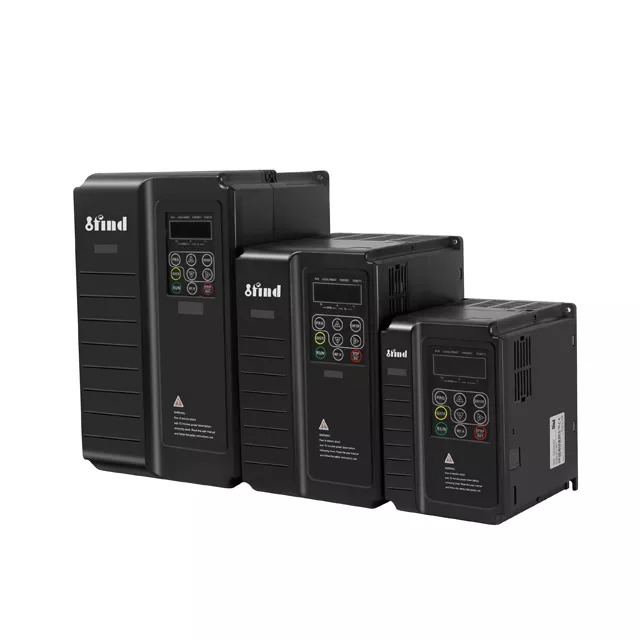
Inverter sizing is the process of selecting an inverter with the appropriate power rating, voltage range, current capacity, overload capability, and operating functions for a specific application.
Choosing an inverter only by comparing its kilowatt rating with the load is not always reliable. A motor may require high starting torque, a solar inverter must match the PV array voltage and current, and a hybrid inverter must supply both continuous and short-term peak loads.
The correct sizing method therefore depends on the type of inverter being used. A VFD for an industrial motor, a grid-tied solar inverter, a hybrid inverter with battery storage, and a solar pump inverter each have different sizing requirements.
What Does Inverter Sizing Mean?
Inverter sizing involves matching the inverter to the electrical and mechanical conditions of the complete system.
The main factors normally include:
Continuous load power;
Peak or surge power;
Motor starting requirements;
Voltage and phase;
Current rating;
Load type;
PV array size;
Battery power and energy capacity;
Operating environment;
Required protection and communication functions.
The inverter must be large enough to operate the intended load safely, but selecting an unnecessarily large model can increase cost, reduce operating efficiency, and make system control less suitable.
The first step is always to identify the inverter type and the load it will control.
Step 1: Identify the Inverter Type
VFD or Frequency Inverter
A VFD controls the speed and torque of an AC motor by changing the output frequency and voltage.
For a VFD, motor rated current and load duty are usually more important than simply comparing the motor’s kilowatt rating with the drive’s kilowatt rating.
Grid-Tied Solar Inverter
A grid-tied solar inverter converts DC power from solar panels into AC power for on-site loads or grid export.
Sizing requires checking PV array power, open-circuit voltage, maximum input current, MPPT voltage range, AC output power, and local grid requirements.
Hybrid Inverter
A hybrid inverter manages solar power, battery storage, grid electricity, and connected loads.
It must be sized according to continuous load power, peak demand, backup requirements, battery power, and the expected operating mode.
For a detailed explanation of its operating modes, see the Hybrid Inverter glossary article.
Solar Pump Inverter
A solar pump inverter converts PV power into controlled AC output for a water pump.
In addition to motor power, the design must consider flow rate, total head, PV array conditions, motor current, pump starting requirements, and water demand.
Because the sizing method varies between these inverter types, the same calculation should not be used for every application.
Step 2: Calculate the Continuous Load
The continuous load is the power that the inverter must supply during normal operation.
For a system with several electrical loads, list each load and determine which loads may operate at the same time. Do not simply add every appliance or machine if some of them are never used simultaneously.
A basic calculation is:
Total continuous load = sum of all loads operating at the same time
For example, if a system supplies lighting, control equipment, a pump, and a communications device, the normal operating power should be calculated based on their actual simultaneous use.
The calculation should include a reasonable engineering margin for measurement error, future changes, and normal operating variation. However, the margin should not be excessive.
Real Power and Apparent Power
Loads are often described in watts or kilowatts, but inverter ratings may also be expressed in VA or kVA.
The relationship can be estimated as:
Apparent power (kVA) = Real power (kW) ÷ Power factor
A load with a lower power factor requires more apparent power and current for the same real power.
For single-phase and three-phase systems, current can be estimated using the following formulas:
Single-phase apparent power:
kVA = Voltage × Current ÷ 1,000
Three-phase apparent power:
kVA = √3 × Voltage × Current ÷ 1,000
These formulas provide an initial estimate. Final sizing should also consider efficiency, harmonics, operating temperature, and the manufacturer’s rating method.
Step 3: Consider Starting and Peak Power
Some loads consume much more power during startup than during normal operation.
Common examples include:
Induction motors;
Pumps;
Compressors;
Refrigeration equipment;
Fans with high inertia;
Transformers;
Certain power tools.
If the inverter cannot supply the starting current, the voltage may drop or the inverter may trip even though the normal running power is within its rating.
VFD Applications
When a motor is controlled by a VFD, the drive can gradually increase the output frequency and reduce starting stress. This usually makes motor starting easier than direct-on-line starting.
However, the VFD still needs to be selected according to:
Motor rated current;
Starting torque;
Load inertia;
Acceleration time;
Overload duty;
Operating speed range.
For heavy-duty applications, the drive may need a higher overload rating even when its standard-duty power rating appears to match the motor. IFIND’s VFD product range can be evaluated according to these motor and load conditions.
Battery and Off-Grid Applications
For an off-grid or backup system, the inverter must support both normal continuous loads and short-term surge loads.
The required surge capacity depends on the equipment. A pump or compressor may require substantially more power during startup than during steady operation.
The system should identify which loads must start at the same time. If several motors start together, the required inverter capacity may be much higher than the sum of their running power.
Step 4: Size a VFD for an AC Motor
VFD sizing should normally begin with motor current rather than motor power.
Check the Motor Nameplate
Confirm the following information:
The VFD output voltage and current must be compatible with the motor.
Evaluate the Load Duty
The load may be classified as variable torque, constant torque, or heavy duty.
Fans and centrifugal pumps are often variable-torque loads. Conveyors, mixers, extruders, compressors, cranes, and lifting equipment may require constant-torque or heavy-duty performance.
A drive that is suitable for a fan may not be suitable for a crane, even if the motor power ratings are similar.
Consider Speed Range
A motor operating at low speed may have reduced cooling if it relies on a shaft-mounted fan. If the motor must operate at low speed for extended periods, additional cooling or a suitable inverter-duty motor may be required.
High-speed operation also requires checking the motor’s mechanical limits, bearing design, and load characteristics.
Check Braking Requirements
High-inertia loads can return energy to the VFD during deceleration. If the DC bus voltage rises excessively, the system may require a braking resistor, braking unit, or regenerative drive.
The deceleration time, load inertia, stop frequency, and required stopping time should be reviewed during sizing.
Step 5: Size a Solar Inverter
Solar inverter sizing involves matching the inverter to both the PV array and the AC load or grid connection.
Check the PV Array Power
The total DC power of the PV array must be within the inverter’s recommended input range.
The appropriate PV-to-inverter ratio depends on the inverter design, local conditions, installation orientation, and system objectives. A slightly oversized PV array may help maintain useful output during weak sunlight, but the inverter’s maximum DC input power must not be exceeded.
Check PV Voltage
The PV string voltage must remain inside the inverter’s operating range.
Check:
Cold-weather open-circuit voltage can be higher than the value measured under normal conditions. This must be considered during string design.
Match the AC Output
The AC output rating should be suitable for the expected load and grid connection.
For a commercial or industrial system, also check:
A solar inverter should not be selected only according to the total PV panel wattage.
Step 6: Size a Hybrid Inverter
Hybrid inverter sizing requires separate consideration of inverter power and battery energy.
Inverter Power
The inverter power rating determines how much load can be supplied at one time.
Check:
Critical loads should be separated from nonessential loads if the system is intended to provide backup during grid outages.
Battery Power
The battery must be able to provide the current required by the inverter. A battery with sufficient energy capacity may still be unsuitable if it cannot deliver the required discharge power.
Battery Energy
Battery energy determines how long the system can operate.
A basic estimate is:
Backup time = Usable battery energy ÷ Average load power
Actual backup time will be lower after considering inverter efficiency, battery discharge limits, temperature, reserve capacity, and load variation.
For example, a system with a high short-term load may require a powerful inverter but may not require long backup duration. Another system with a smaller load operating overnight may require less inverter power but greater battery energy capacity.
Operating Priority
The intended operating mode also affects sizing. Solar self-consumption, peak-load management, emergency backup, and off-grid operation may require different settings and capacity margins.
Step 7: Size a Solar Pump Inverter
Solar pump sizing should begin with the water requirement rather than the inverter.
Calculate Required Flow
Determine how much water must be delivered per day, hour, or irrigation cycle.
The calculation should consider:
Calculate Total Dynamic Head
Total dynamic head may include:
The pump must be selected according to both flow and head.
Match the Motor and Inverter
Check the pump motor’s voltage, phase, rated current, frequency, power, and starting characteristics.
The solar pump inverter must also support the PV array’s input voltage and current. A motor power rating alone cannot confirm whether the complete solar pumping system is correctly sized.
Consider PV Conditions
Solar irradiance changes throughout the day. The PV array must provide sufficient voltage for the inverter to start and enough power for the pump to operate reliably.
The system should account for temperature, shading, dust, cable losses, and seasonal changes.
Common Inverter Sizing Mistakes
Selecting Only by Kilowatt Rating
Two inverters with the same kilowatt rating may have different overload capacity, surge performance, current ratings, or operating limits.
Ignoring Starting Current
Motors and compressors may trip an undersized inverter during startup even when their running power appears acceptable.
Using the Wrong Load Classification
A heavy-duty conveyor or crane should not be sized like a variable-torque fan.
Ignoring Temperature and Altitude
Some inverters require output derating at high ambient temperatures or high installation altitudes. Ventilation and enclosure design can also affect the usable capacity.
Oversizing Without a Purpose
An oversized inverter costs more and may operate inefficiently at very light loads. Extra capacity should be based on a real requirement, such as future expansion, surge demand, or heavy-duty operation.
Confusing Power Capacity with Energy Capacity
In hybrid systems, inverter power determines how much load can run at once. Battery energy determines how long the load can run.
These are related but different sizing factors.
Inverter Sizing Checklist
Before selecting an inverter, confirm:
Inverter type;
Continuous load power;
Peak and starting power;
Motor rated current;
Load torque characteristics;
Input voltage and phase;
Output voltage and phase;
PV voltage and current;
Battery power and energy, if applicable;
Required backup duration;
Braking requirements;
Operating temperature;
Altitude and enclosure;
Communication requirements;
Local electrical and grid regulations.
FAQs
What is inverter sizing?
Inverter sizing is the process of selecting an inverter with suitable power, current, voltage, overload, input, and control capabilities for a specific load and operating environment.
Should I size an inverter according to watts or amps?
Both may be required. For simple loads, watts or kilowatts provide a starting point. For motors and industrial equipment, rated current, power factor, starting current, overload capacity, and load type are also important.
There is no universal percentage that applies to every system. The required margin depends on starting loads, future expansion, temperature derating, load variation, and application duty.
A reasonable engineering margin is useful, but excessive oversizing can increase cost and reduce efficiency.
How do I size a VFD for a motor?
Check the motor’s rated current, voltage, phase, power, frequency, speed, and load type. Then evaluate starting torque, overload duty, acceleration, deceleration, braking, and low-speed cooling.
The VFD should be selected according to the motor and application requirements, not power rating alone.
How do I size a hybrid inverter?
Calculate continuous load power, peak starting power, backup loads, battery discharge power, battery energy capacity, PV input, and desired backup duration.
The inverter power rating and battery energy capacity should be calculated separately.
Can I use a larger inverter than the load requires?
A larger inverter may be suitable when future expansion, high starting power, or additional backup loads are expected.
However, unnecessary oversizing increases system cost and may reduce efficiency at low load. The additional capacity should have a clear engineering purpose.
How do I size a solar pump inverter?
Start with the required water flow and total head. Then select a compatible pump and match the inverter to the pump motor’s voltage, current, phase, power, and starting requirements.
The PV array must also remain within the inverter’s permitted voltage and current range.
Conclusion
Inverter sizing is more than matching a product’s kilowatt rating to the load. The correct method depends on whether the system uses a VFD, grid-tied solar inverter, hybrid inverter, or solar pump inverter.
Motor current, starting torque, load type, PV input, battery capacity, operating temperature, braking requirements, and backup conditions may all affect the final selection.
A properly sized inverter should operate the load reliably without unnecessary oversizing. By evaluating the complete electrical, mechanical, and environmental conditions, engineers can select an inverter that provides suitable performance, protection, and operating efficiency.
Need Help Choosing the Right Inverter Capacity?
Share your motor or load rating, input power conditions, PV or battery requirements, and intended application with the IFIND team. We can help evaluate a suitable inverter capacity and configuration for your system.
Discuss Your Inverter Sizing Requirements