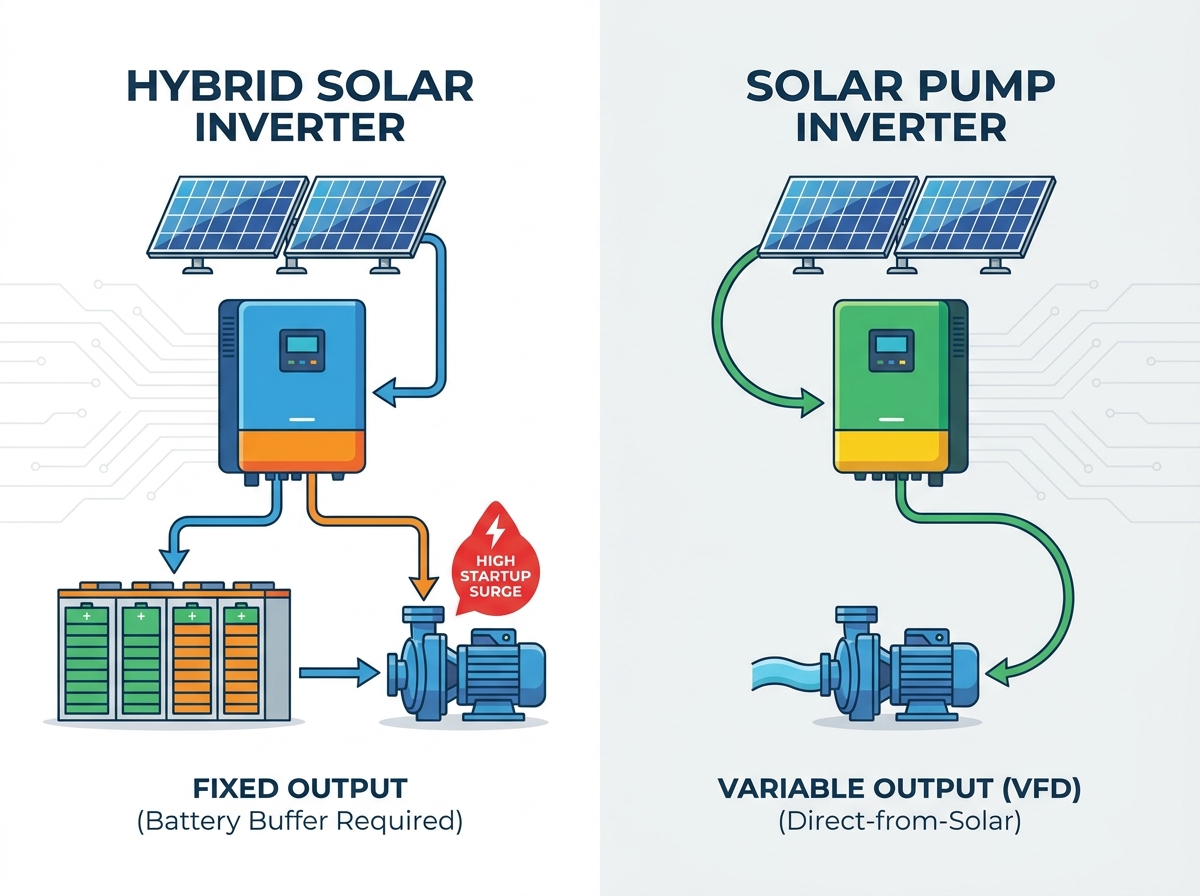
Modern agricultural irrigation demands reliable off-grid power to thrive. However, pairing high-surge water pumps directly to the wrong inverter creates serious operational trouble. You might face frequent system faults, premature motor burnout, or bloated battery budgets. Farm operators often confuse standard solar hybrids seamlessly alongside dedicated pump drivers. The critical difference lies directly in their specific output profiles. Standard units provide rigid, stable voltage designed exclusively for general household appliances. Conversely, specialized agricultural units provide dynamic frequency control essential for heavy inductive loads. This guide breaks down the technical outputs of both distinct systems thoroughly. It will help you evaluate which exact inverter architecture prevents catastrophic motor damage reliably. You will also learn how to align these equipment choices perfectly against your overall irrigation deployment strategy.
Key Takeaways
Load Profiles Dictate Choice: Standard off-grid hybrid inverters output fixed voltage/frequency ideal for stable farm electronics, while a dedicated solar pump inverter outputs variable frequency to safely manage a water pump's massive startup surge.
Battery Dependency: Hybrid setups require expensive battery banks to buffer pump startup currents. Pump inverters operate directly from solar panels (batteries optional/excluded), significantly lowering CAPEX.
Motor Longevity: Dedicated pump inverters utilize VFD (Variable Frequency Drive) technology to soft-start motors, reducing mechanical stress on impellers and extending pump lifespan.
Implementation Reality: If the sole goal is moving water into a reservoir during daylight, a solar pump inverter is the most cost-effective and efficient choice.
Framing the Problem: Why Inductive Motor Loads Demand Specific Outputs
Farmers frequently encounter a frustrating barrier when designing remote irrigation systems. AC water pumps act as massive inductive loads. Whether you deploy deep-well submersible pumps or high-flow surface transfer pumps, they share one demanding characteristic. They require three to seven times their normal running current just to start moving the impeller. This massive inrush current happens because the motor must overcome high resting inertia instantly.
A common mistake operators make involves ignoring the starting requirements of single-phase or three-phase pumps. They mistakenly assume the running watts listed on the motor plate represent the absolute maximum draw. This false assumption leads directly to instantly overloaded and permanently damaged equipment.
This startup surge creates immediate, severe problems for standard power systems. A standard hybrid system reads this brief surge as a massive electrical short circuit. It will immediately trigger built-in overload protection mechanisms and shut down completely. To avoid this annoying tripping issue, you would need to purchase a massively oversized standard unit. This approach wastes significant budget on excess power capacity you only use for three brief seconds during startup.
We can solve this dilemma by understanding basic solar pump inverter basics. True pump controllers bypass this surge problem elegantly. They do not attempt to offer raw, brute-force electrical power. Instead, they intelligently alter the actual output frequency (Hz) and voltage (V) simultaneously. This gradual electrical adjustment eases the heavy motor up to its operational speed safely. It protects the physical impeller and deeply reduces dangerous water hammer effects inside your PVC pipes.
Off-Grid Hybrid Inverter Output Characteristics
Engineers design the standard off-grid hybrid inverter around a strictly fixed output architecture. It consistently produces a rigid 120V or 230V sine wave alongside a steady 50Hz or 60Hz frequency. This intentional rigidity perfectly mimics a highly stable municipal city grid. It effectively and safely powers delicate electronics, desktop computers, and standard farm household appliances.
However, this fixed output creates an immediate, costly dependency on chemical energy storage. When a heavy inductive motor requests an instantaneous current spike, the power system must deliver it immediately. Solar panels cannot magically ramp up production in milliseconds to meet this massive electrical spike. Therefore, hybrids rely entirely on massive battery banks to act as an instantaneous buffer. The batteries alone supply the sudden, massive current needed to start heavy inductive loads.
This fixed-output system shines brightly in specific, multi-use agricultural scenarios. It proves highly ideal when a remote farm requires continuous 24/7 power for mixed electrical loads. You can comfortably run security camera networks, barn lighting, environmental monitoring sensors, and small intermittent domestic pumps simultaneously.
Unfortunately, this rigid architecture introduces severe commercial drawbacks for dedicated high-volume agricultural irrigation. Relying heavily on chemical batteries for high-surge agricultural pumping degrades them exceptionally fast. Deep, sudden electrical discharges limit battery cycle life significantly, regardless of expensive lithium or traditional lead-acid chemistries. Furthermore, buying enough raw battery capacity to handle pump surges safely drastically increases your initial system capital costs.
Solar Pump Inverter Output Characteristics
A dedicated solar pump inverter takes a radically different approach to heavy motor control. It integrates sophisticated Variable Frequency Drive (VFD) technology directly into its core processing architecture. When you turn this specialized system on, it does not instantly deliver a full 50Hz or 60Hz. Instead, it slowly ramps up the electrical frequency from 0Hz over several critical seconds. This gentle "soft start" mechanism completely eliminates the massive, dangerous surge current.
Best practice dictates utilizing this Variable Frequency Drive technology for any agricultural motor exceeding 1HP. Soft-starting reduces immediate mechanical stress on the critical pump bearings. It extends the physical lifespan of the delicate impeller significantly. It also drastically reduces dangerous water hammer impacts on your underground PVC pipe joints.
Additionally, these specialized units optimize raw DC power directly from your solar PV array. They feature advanced Maximum Power Point Tracking (MPPT) logic tuned specifically for active direct-drive applications. The controller dynamically adjusts the pump's rotational speed based on real-time solar irradiance levels. If a heavy cloud passes slowly over your solar panels, the motor simply slows down safely. It will not trip an alarm or shut off abruptly. It simply moves less water smoothly until the intense sun returns fully.
Phase compatibility represents another massive, vital advantage for smart farm operators. Specialized controllers are specifically engineered to drive both single-phase and heavy three-phase AC pumps easily. Heavy agricultural operations almost exclusively rely on highly efficient, durable three-phase motors. Standard hybrid systems typically only output single-phase power. This frustrating limitation restricts your heavy equipment choices severely.
The resulting commercial benefit remains undeniable for modern agricultural planners. You achieve high-volume daily water displacement smoothly, safely, and highly reliably. More importantly, you accomplish this massive task without facing recurring replacement costs for degraded battery storage ever again.
Side-by-Side Evaluation Matrix: Cost, Efficiency, and Application
Comparing these distinct architectures highlights major operational differences for farm managers. The final decision often comes down to upfront capital expenditure (CAPEX) versus ongoing operational expenses (OPEX). Below is a clear comparison matrix detailing the exact differences.
Comparison of Solar Inverter Architectures for Irrigation Loads
Evaluation Metric
Standard Off-Grid Hybrid Inverter
Dedicated Solar Pump Inverter
Initial Capital Cost (CAPEX)
Very High (Requires large battery banks and system oversizing)
Very Low (Requires only solar PV panels and the control unit itself)
Ongoing Operational Cost (OPEX)
High (Demands complete battery replacements every 3 to 7 years)
Near-Zero (Minimal maintenance required over a typical 10-year lifespan)
Inductive Surge Handling
Relies entirely on chemical battery burst capacity to survive spikes
Uses dynamic VFD soft-start frequency ramping to eliminate spikes
Overall Energy Efficiency
Lower (Suffers unavoidable battery charge and discharge conversion losses)
Higher (Utilizes direct DC to AC instantaneous conversion natively)
High (Simplified direct-drive architecture removes standard failure points)
When we evaluate CAPEX rigorously, hybrids show distinct, undeniable disadvantages for simple bulk water pumping. They require exceptionally high initial investments primarily because of mandatory, expensive battery banks. You also face much higher OPEX eventually because you must replace those expensive batteries every three to seven years. Heavy motor surges degrade delicate battery plates significantly faster than normal household loads ever do.
Conversely, dedicated variable frequency variants demand a remarkably lower initial cost. You only purchase the bare solar panels and the robust controller unit. This streamlined direct-drive approach results in near-zero OPEX moving forward for the farm.
System energy efficiency also strongly favors specialized direct motor drives. Dedicated controllers maintain much higher overall system efficiency for daily water delivery. They completely avoid the unavoidable, wasteful conversion losses universally associated with charging and discharging chemical batteries constantly.
Finally, system reliability increases drastically in remote, unmonitored agricultural locations. Direct-drive solar architectures feature far fewer internal electronic components. Fewer active, heat-generating parts mean fewer potential points of catastrophic failure. This rugged simplicity proves absolutely invaluable in harsh, dusty, and hot agricultural environments worldwide.
Implementation Risks: Sizing, Compliance, and Environmental Durability
Proper system design requires strict, unwavering adherence to precise load sizing rules. You must fully understand your specific inductive load perfectly before purchasing expensive equipment. A highly common engineering rule of thumb applies heavily here. Never attempt to match a 2kW water pump directly with a 2kW hybrid inverter.
Standard hybrids need massive 3x to 5x oversizing just to survive the initial startup current safely. This mathematically means a 2kW pump might demand an 8kW or 10kW standard hybrid system. In sharp contrast, specialized direct-drive models operate completely differently. They typically only need 1.3x to 1.5x oversizing for the total solar PV input capacity. This minimal oversizing allows them to function optimally even during slightly cloudy conditions without breaking your budget.
Environmental protection plays a vital, non-negotiable role in long-term system longevity. Agricultural sites frequently expose sensitive electronics to extreme, punishing outdoor conditions. You must actively prioritize certified IP65-rated enclosures for your main irrigation controllers. Installers frequently mount these specific rugged units outdoors, directly near wet wellheads or open, humid reservoirs. Standard hybrid controllers usually feature much lower IP20 or IP21 protection ratings. They strictly require climate-controlled, completely dry, and dust-free indoor mounting spaces. Most remote farms simply lack these pristine indoor conditions entirely.
We must also shift our core architectural mindset regarding bulk energy storage completely. Farm operators need to evaluate physical water storage versus chemical energy storage critically. Specialized controllers cleverly treat physical water tanks as the actual "battery" of the entire system. Pumping heavy water uphill into a raised reservoir stores massive potential energy efficiently during the day. A physical steel or solid concrete water tank remains infinitely cheaper to build. It also proves vastly more durable and significantly more reliable than a sensitive, degrading rack of chemical batteries.
Shortlisting Logic: Which Inverter Architecture Do You Need?
Selecting the exactly correct processing hardware requires a crystal-clear understanding of your daily operational goals. You can easily simplify this complex procurement process by reviewing a few strict, logical criteria.
Choose a standard off-grid hybrid system if your farm deployment strictly meets the following conditions:
You actively need to power a whole farm building, remote office, or off-grid living cabin.
You absolutely require guaranteed electrical power access during dark nighttime hours for security or lighting.
The water pump itself represents only a very minor fraction of your total daily electrical load.
Your operation regularly runs delicate electronics requiring pure, rigidly stable sine wave power continuously.
You have confidently secured sufficient budget for a large, high-quality, long-lasting battery bank upfront.
Choose a specialized solar pump solution if your agricultural situation closely matches these specific factors:
Your primary business objective strictly involves bulk agricultural irrigation or remote heavy water transfer operations.
Your pumping operation occurs entirely and safely during active, sunny daylight hours.
You utilize heavy-duty three-phase AC pumps for maximum mechanical efficiency and deep-well lifting power.
You aggressively want to minimize ongoing maintenance labor and reduce your initial capital expenditure drastically.
You strongly prefer storing bulk water directly in elevated physical tanks rather than storing electricity in degrading batteries.
Conclusion
Do not incorrectly force a general-purpose electrical tool into a highly specialized mechanical job. Large-scale agricultural irrigation introduces extreme mechanical demands that standard equipment cannot handle. The variable-frequency output of a dedicated direct pump drive remains technically superior for this specific task. It remains fundamentally safer for the delicate motor itself. Furthermore, it represents a significantly financially sounder investment than a standard hybrid system. You eliminate the costly battery bottleneck completely from your infrastructure.
Before you confidently proceed with any purchase, take specific actionable steps today. First, carefully audit your existing pump's phase requirements directly from the metal spec plate. Verify exactly whether you currently run a single-phase or three-phase motor. Next, precisely document the exact startup current and rated running power. Finally, bring these precise technical specifications directly to your vendor before ever requesting quotes. This diligent technical preparation guarantees you buy the perfectly correct output architecture on the first try.
FAQ
Q: What is the difference between a standard VFD and a solar pump inverter?
A: Solar variants feature specialized built-in MPPT logic. Engineers tune this logic specifically to safely handle rapidly fluctuating DC input from solar panels. Standard VFDs expect highly stable, continuous AC power from a municipal grid. If you connect solar panels directly to a standard VFD, fluctuating voltage will cause it to crash instantly.
Q: Can a solar pump inverter run without batteries?
A: Yes. This directly represents its absolute primary design advantage. It operates flawlessly in direct response to available sunlight. The system drives the heavy motor solely using real-time DC power generated by your photovoltaic array. This smart direct-drive capability completely eliminates ongoing battery replacement costs.
Q: Can I use a solar pump inverter for normal household appliances?
A: No. The specialized variable frequency output changes dynamically during operation. It slowly ramps up voltage and frequency intentionally to start heavy motors softly. This aggressively fluctuating output will instantly damage sensitive standard electronics. Televisions, laptops, and refrigerators require a rigidly fixed electrical frequency to survive.
Q: Do I need a single-phase or three-phase solar pump inverter?
A: Your ultimate choice must exactly match the wiring configuration and specification plate of your physical water pump. If you install a three-phase motor in the deep well, you absolutely must purchase a three-phase controller to drive it properly. Never mismatch electrical phase outputs under any circumstances.