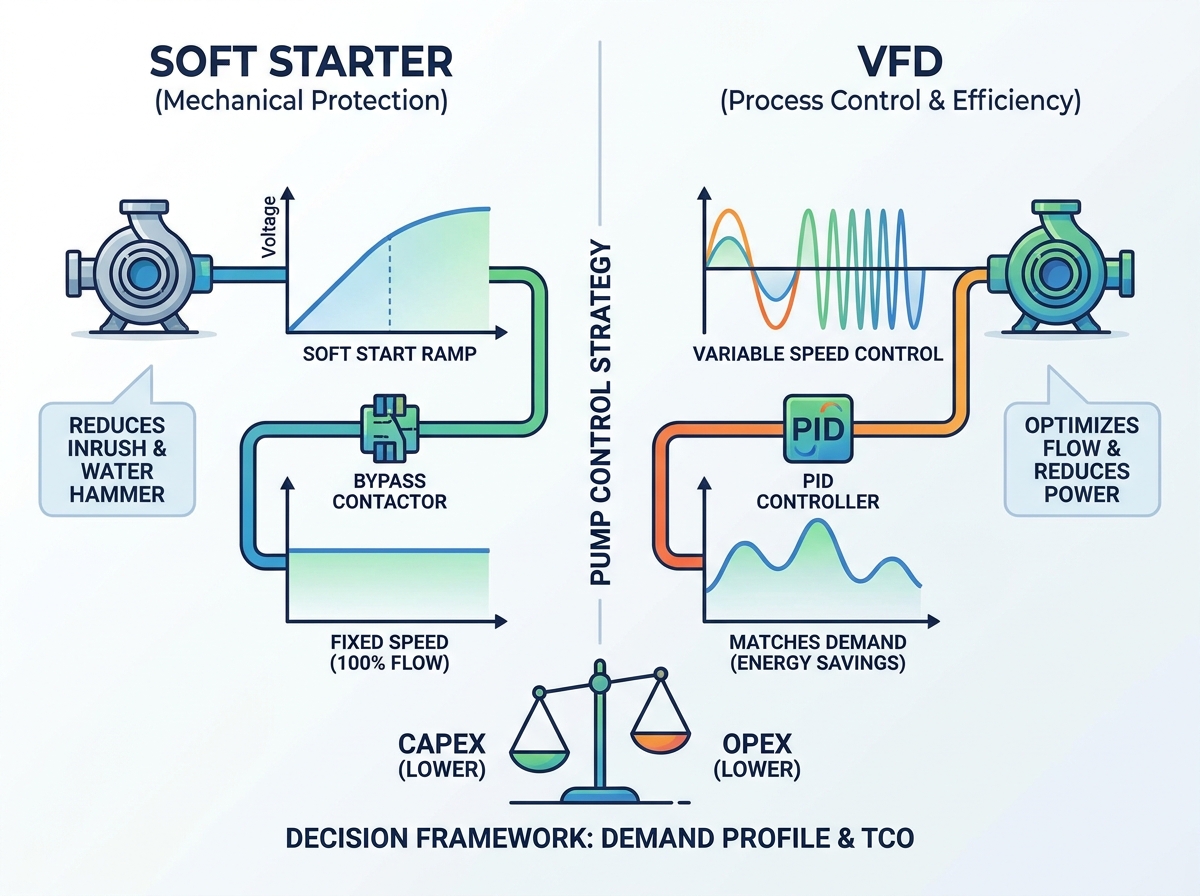
Upgrading or designing pump motor control systems often leads to a binary choice. You must choose between Variable Frequency Drives (VFDs) and Soft Starters. Choosing the wrong technology inflates capital expenditure unnecessarily. Conversely, it leaves significant long-term energy savings on the table. Both devices successfully reduce electrical and mechanical stress during motor startup. However, their operational capabilities diverge significantly once the pump reaches full speed. You need the right technology for your specific application requirements. This guide provides an objective, engineering-focused evaluation framework. We aim to help facility managers and system integrators align their pump control strategy accurately. You will learn how to match equipment to actual process demands, operational constraints, and lifecycle budgets. We also explore the physical dynamics of motor starts and compliance risks.
Key Takeaways
Primary function divergence: Soft starters are designed primarily for inrush current mitigation and preventing water hammer during start/stop cycles, whereas VFDs provide continuous speed and flow regulation.
Energy economics: VFDs yield significant ROI in variable-flow systems through the Pump Affinity Laws, but offer zero energy advantage in systems that run continuously at 100% capacity.
Implementation complexity: VFDs require strict attention to harmonic distortion, motor cooling, and bearing protection, while soft starters offer a smaller footprint and simpler integration.
TCO perspective: Base the final decision on total cost of ownership (TCO)—weighing upfront capital cost against lifecycle energy savings and maintenance overhead.
Defining the Baseline: AC Motor Drive Fundamentals and Pump Dynamics
Across-the-line starting presents a major physical challenge for any industrial pumping system. Starting an induction motor directly from the utility grid draws massive electrical current. It typically pulls six to eight times the motor's full load amperage (FLA). This immense current draw sags the local utility grid. It dims facility lights and trips sensitive electronic equipment nearby. Furthermore, it generates extreme mechanical torque instantaneously.
This sudden jolt applies severe mechanical shear directly to pump impellers. It strains pipe fittings and damages motor couplings over time. Solid-state motor controllers effectively resolve this core issue. They provide controlled acceleration profiles during startup. Understanding basic AC motor drive fundamentals remains essential here. This knowledge helps you evaluate your system correctly. You must determine if your pumping application simply requires transient control during starting and stopping. Alternatively, you might need continuous dynamic control across all operating hours.
Evaluating Soft Starters for Mechanical Protection
Soft starters utilize solid-state components called thyristors, or silicon-controlled rectifiers (SCRs). These components control the incoming AC voltage dynamically. They effectively chop the AC waveform. This action limits the voltage delivered to the motor terminals initially. The controller gradually increases the voltage as the motor accelerates. This smooth ramp-up prevents sudden mechanical shocks. Motor torque increases steadily.
Once the motor reaches its synchronous operating speed, a bypass contactor engages automatically. The contactor bridges the power circuit across the SCRs. The motor then runs directly on utility grid power. The SCRs drop out of the active circuit completely. This design achieves near-perfect operational efficiency.
Basic dewatering applications in mining or construction.
Long-distance transfer pumps pushing fixed fluid volumes.
Applications prioritizing water hammer elimination.
Systems needing simple pipe cavitation prevention.
Every technology carries inherent compromises. Consider the following pros and cons from a skeptical engineering perspective:
Pros: Soft starters demand significantly lower upfront capital expenditure. They achieve 99% operational efficiency when bypassed. They feature a very compact panel footprint. They generate minimal internal heat during continuous operation.
Cons: They force the motor to run at a fixed speed continuously. Operators rely entirely on mechanical throttling valves to control fluid flow. Throttling a pump wastes immense amounts of electrical energy. The motor runs at full power while valves artificially restrict the output.
Evaluating VFDs for Pump Applications: Process Control and Efficiency
Variable Frequency Drives operate differently from soft starters. A VFD first converts incoming AC utility power into DC power using a rectifier bridge. Capacitors then smooth this DC bus voltage. Next, an inverter section utilizes Insulated-Gate Bipolar Transistors (IGBTs). These transistors fire rapidly using Pulse Width Modulation (PWM). This creates a simulated AC output waveform. It allows the drive to alter both frequency and voltage simultaneously.
Deploying VFDs for pump applications hinges entirely on the Pump Affinity Laws. These laws describe fluid dynamics strictly. Flow relates directly to motor speed. Head pressure relates to the square of motor speed. Most importantly, power consumption relates to the cube of motor speed. Dropping your pump speed by just 20% yields nearly a 50% reduction in energy consumption. This exponential relationship drives massive operational savings.
Modern drives also offer advanced internal capabilities. Integrating constant-pressure pump PID control directly within the drive simplifies system architecture. The drive reads analog signals from downstream pressure transducers directly. It automatically adjusts pump speed to match fluctuating system demands. You eliminate external Programmable Logic Controllers (PLCs) entirely. You also eliminate wasteful throttling valves and mechanical bypass loops.
We must evaluate VFDs objectively against their drawbacks:
Pros: They deliver maximum energy optimization for variable loads. They provide incredibly precise process control. They reduce mechanical wear on seals and bearings during continuous operation.
Cons: They carry a higher initial cost. They often cost two to three times more than equivalent soft starters. They generate electrical harmonics. They require much larger enclosures to dissipate generated heat safely.
The Decision Framework: Feature-to-Outcome Matrix
System demand profiles dictate the correct hardware choice instantly. Look closely at your daily flow requirements. Variable demand systems require dynamic adjustments. If your flow or pressure requirements fluctuate throughout the day, you need a VFD. Constant demand systems operate differently. If your pump always fills a storage tank at maximum capacity, choose a soft starter. Continuous full-speed operation neutralizes a VFD's energy-saving capabilities.
You must also assess local grid and power quality constraints. Some utilities impose strict limits on motor starting currents. Soft starters excel in limiting this initial current surge. However, advanced VFDs can start heavy motors at near 1x FLA if programmed correctly.
Financial calculations should guide your final engineering specification. Avoid the common trap of evaluating hardware price tags alone. Instead, compare your upfront capital expenditure against projected annual energy savings. Base this analysis strictly on your actual operational duty cycle. Most variable-flow systems establish a clear break-even timeline quickly. You typically recoup the initial VFD premium within 12 to 24 months.
Table 1: Pump Control Technology Comparison
System Feature
Soft Starter
Variable Frequency Drive (VFD)
Starting Current
2x to 3x FLA
Near 1x FLA
Continuous Speed
Fixed (100%)
Variable (0% to 100%+)
Energy Savings
None
High (Affinity Laws apply)
Initial Cost
Low
High
Harmonic Distortion
Minimal
Requires mitigation (IEEE 519)
Ideal Application
Constant flow, dewatering
Variable demand, closed loops
Implementation Risks and Compliance Considerations
Deploying solid-state motor controllers introduces specific engineering risks. You must evaluate these risks before finalizing your panel design.
Harmonics: Non-linear loads draw distorted current waveforms. This creates electrical harmonics on your facility grid. You must evaluate IEEE 519 compliance strictly. Installations may require input line reactors or active harmonic filters.
Motor Stress: Rapid PWM switching creates severe dV/dt voltage spikes. These fast-rising spikes reflect at the motor terminals. They easily puncture standard motor winding insulation. You must specify inverter-duty motors. Furthermore, high-frequency switching induces shaft voltages. These voltages discharge through the bearings. You must install grounding rings to prevent destructive bearing fluting.
Cooling: VFDs are not perfectly efficient. They dump roughly 3% of their rated power as heat into the enclosure. Panel HVAC design becomes critical. You must calculate heat loads accurately to prevent drive failures.
Soft starter rollout risks center around thermal limitations. Duty cycle limits present a major constraint. SCRs handle massive currents during startup. They heat up rapidly. Soft starters are not suitable for applications requiring highly frequent starts and stops within a short window. Exceeding the manufacturer's starts-per-hour rating causes thermal overload. The SCRs will fail catastrophically.
Use a strict shortlisting logic before requesting vendor quotes. Do not buy hardware blindly. Document your required operational data first. Gather all relevant pump curves. Map out your daily and weekly flow profiles. Record the exact motor nameplate specifications. Give this comprehensive data package to your electrical integrator to ensure optimal sizing.
Conclusion
Neither technology serves as a universally superior solution. Soft starters remain the pragmatic, cost-effective choice for mechanical protection in steady-state pumping. They prevent water hammer efficiently while minimizing capital spend. Conversely, VFDs stand as the strategic choice for variable-demand systems. They unlock massive energy optimization and enable precise PID regulation.
Conduct a thorough flow profile audit of your current system before buying equipment. Consult your mechanical engineering partner to map out your exact duty cycles. Always finalize your operational data before writing your electrical specifications.
FAQ
Q: Can a VFD completely replace a soft starter?
A: Yes. A VFD inherently provides soft starting capabilities by ramping up voltage and frequency smoothly. However, over-specifying a VFD solely for its starting function represents a poor allocation of capital. Use a VFD only if you need variable speed during continuous operation.
Q: Will a VFD always save energy in pump applications?
A: No. If your pump operates continuously at 100% speed, a VFD offers zero energy advantages. It will actually consume 2-3% more energy than a bypassed soft starter due to internal switching and heat losses.
Q: Do I need a special motor to use a VFD or Soft Starter?
A: Soft starters work perfectly with standard induction motors. VFDs generally require specific "inverter-duty" motors. These motors feature upgraded winding insulation to withstand severe voltage spikes. They also require grounding rings to prevent premature bearing failure caused by shaft voltages.