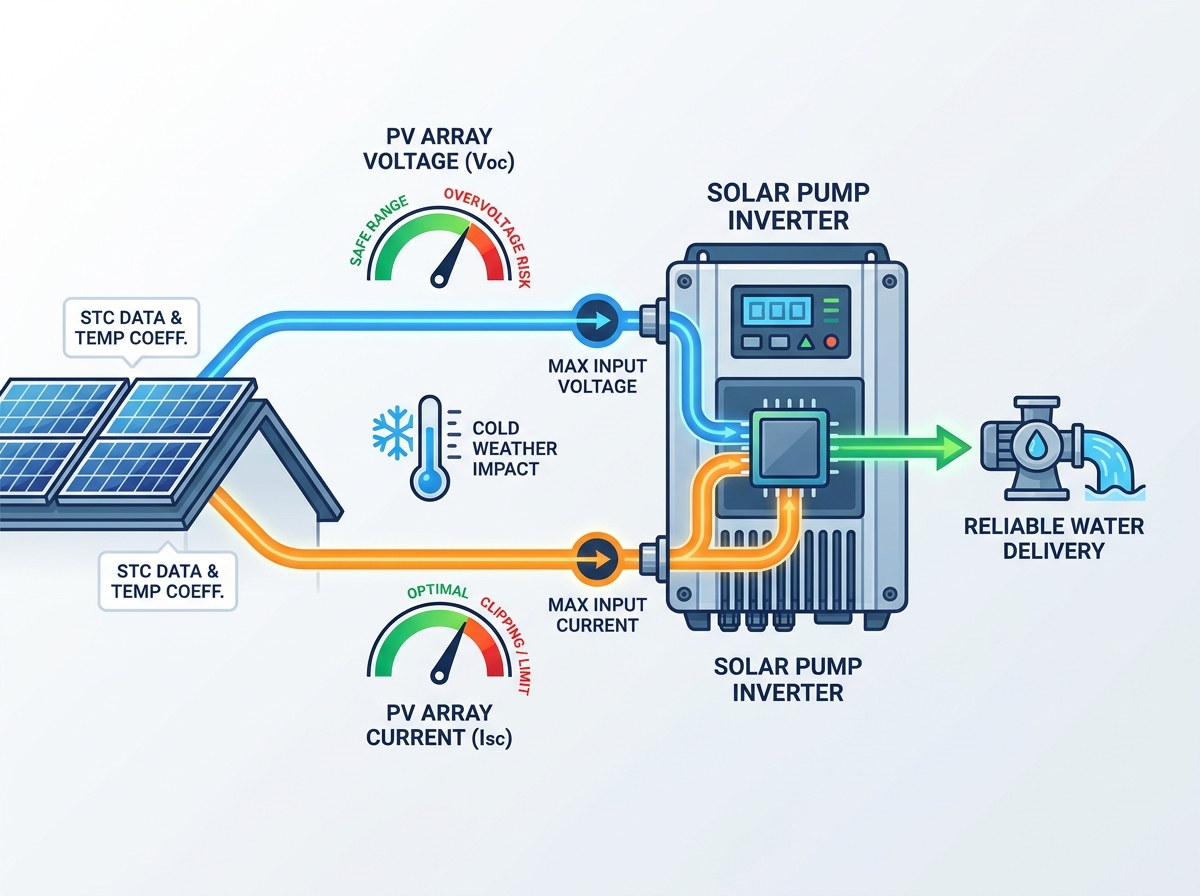
Sizing a photovoltaic array for a solar water pumping system demands precise mathematics beyond merely matching total wattage. Relying solely on aggregate power (kW) often leads to devastating hardware failure, suboptimal daily yields, and completely voided manufacturer warranties. The commercial reality is harsh but entirely avoidable. The longevity of your solar controller relies heavily on strict adherence to the open-circuit voltage (Voc) and short-circuit current (Isc) limits of your chosen PV array. Exceeding these specific thresholds guarantees catastrophic internal damage. This article provides a definitive, decision-stage framework for agricultural and industrial operators. We will guide you through validating PV voltage and current specifications against inverter limitations. You will learn exactly how to match panel strings properly. This ensures reliable, continuous water delivery across varying environmental conditions without risking expensive infrastructure.
Key Takeaways
Total wattage is a secondary metric; matching the PV array’s Maximum Voc and Isc to the inverter’s input limits prevents immediate hardware damage.
Temperature coefficients must be factored into voltage calculations, as cold weather spikes panel voltage beyond standard testing conditions (STC).
Selecting an inverter with a robust maximum power point tracking range ensures higher daily water yields during low-light conditions.
Intentional, calculated DC over-sizing (clipping) is standard practice for consistent flow, provided the hard voltage and current limits are never breached.
The Operational Impact of Precise PV Sizing
An improperly sized array creates severe operational bottlenecks. You will experience frequent system shutdowns due to undervoltage. Alternatively, you risk catastrophic hardware failure from overvoltage. Both scenarios lead directly to costly agricultural or industrial downtime. Operators cannot afford sudden irrigation halts during peak growing seasons. A well-calculated array prevents these costly interruptions.
You must establish strict success criteria for your sizing calculations. A MPPT solar pump inverter requires a delicate balance. The pump should operate at optimal capacity during peak midday hours. However, you must never risk overwhelming internal circuitry during cold, high-irradiance mornings. Proper sizing achieves this equilibrium.
Consider the cost-to-outcome ratio carefully. Spending an extra hour on precise string calculation pays massive dividends. You prevent the immediate cost of replacing fried controllers. More importantly, you avoid enduring catastrophic crop loss due to unexpected water scarcity. Precision math acts as an insurance policy for your entire agricultural operation.
Voltage Checks: Matching Array Voc to the MPPT Solar Pump Inverter
Open Circuit Voltage (Voc) remains your single most critical evaluation metric. This value represents the maximum voltage a solar panel produces under zero-load conditions. Exceeding the maximum input voltage guarantees instantaneous destruction. The DC bus capacitors inside the controller will burst. You cannot repair this damage; you must replace the entire unit.
Efficiency relies heavily on the operating voltage window. A broad maximum power point tracking range dictates how effectively the system extracts energy. The string's Voltage at Maximum Power (Vmp) must fall comfortably within this specified window. When Vmp aligns correctly, the controller optimizes energy extraction perfectly throughout the day.
Cold weather creates a significant implementation risk. Many installers forget to account for temperature coefficients. Solar panels generate much higher voltages in freezing conditions compared to standard testing conditions (STC). You must calculate the absolute worst-case Voc. Follow these steps to ensure safety:
Identify the historical record low temperature for your installation site.
Locate the panel's negative voltage temperature coefficient (typically around -0.3% per °C) on the spec sheet.
Calculate the temperature difference between STC (25°C) and your record low.
Multiply the difference by the coefficient to find the voltage increase percentage.
Add this percentage to the STC Voc rating to determine your absolute maximum string voltage.
Current (Amperage) Checks: Preventing Inverter Bottlenecks
Understanding current constraints prevents long-term hardware degradation. Operational current (Imp) differs significantly from absolute maximum short-circuit current (Isc). Spec sheets list both values clearly. The total Isc of your solar string must never exceed the maximum allowable input current of your equipment. Ignoring this rule causes severe internal overheating.
Combining multiple PV strings in parallel introduces specific risks. Parallel wiring keeps voltage the same but multiplies the amperage. Two strings of 10 amps become one feed of 20 amps. This rapid multiplication quickly approaches the absolute input limits of many standard controllers. You must meticulously check parallel string totals against input tolerances.
Current clipping is a known industry reality. Modern systems often "clip" or reject excess current safely. They do this successfully only if the voltage stays within the approved range. However, continuous operation at absolute maximum current limits degrades components. Thermal management systems work constantly to shed heat. Over time, this intense thermal cycling shortens the lifespan of critical electronic parts.
Sustaining Solar Pump Operation Under Changing Sunlight
Dynamic irradiance constantly challenges your agricultural irrigation setup. Cloud cover, dawn, and dusk cause rapid voltage and current drops. An inverter's minimum startup voltage specification truly matters in these scenarios. A lower startup threshold means your pump begins delivering water earlier in the morning. It also continues pumping later into the evening.
Variable Frequency Drive (VFD) integration solves power fluctuation problems smoothly. The controller adjusts the pump's motor speed (Hz) in real-time. It directly matches the fluctuating current provided by the PV array. This continuous adjustment optimizes solar pump operation under changing sunlight. It ensures you maximize water volume without risking unexpected motor stalls.
Software protections prevent mechanical disasters during low-light conditions. You need strong dry-run and low-power safety features. When sunlight drops drastically, the pump motor might stall while attempting to draw unavailable power. This stalling causes rapid overheating. Intelligent controllers detect this drop immediately. They safely pause operation rather than burning out expensive submersible motors.
Evaluation Criteria: Shortlisting the Right Inverter for Your Array
You need a clear evaluation lens for comparing spec sheets. Spec-to-outcome mapping simplifies procurement significantly. Look for MPPT efficiency ratings exceeding 99%. Ensure the device offers exceptionally broad input voltage ranges. For outdoor agricultural setups, demand robust IP65+ enclosures. These enclosures keep aggressive dust, insects, and moisture away from sensitive circuit boards.
Non-negotiable built-in protections must be present. Do not purchase equipment lacking comprehensive safety features. You require built-in overvoltage and overcurrent safeguards. Reverse polarity protection saves systems from accidental wiring errors during installation. Integrated surge protection devices (SPD) defend your investment against nearby lightning strikes.
Scalability ensures your operation remains future-proof. Check if the hardware supports hybrid capabilities. Some controllers accept both AC grid input and DC solar input seamlessly. This dual compatibility proves essential for operations requiring 24/7 pumping regardless of local weather patterns.
Inverter Specification Evaluation Matrix
Specification Metric
Standard Requirement
Premium Outcome
MPPT Efficiency
> 98%
Maximizes daily water output during cloudy periods.
Enclosure Rating
IP20 (Indoor) / IP65 (Outdoor)
Prevents dust and moisture from destroying circuits.
Overvoltage Protection
Mandatory Automatic Shutdown
Saves DC bus capacitors from instant destruction.
Hybrid Input Support
AC / DC Auto-Switching
Enables continuous nighttime or rainy day irrigation.
Implementation Risks and Setup Realities
Even perfect sizing calculations fail if field execution is poor. Wiring and MC4 connector failures represent a massive vulnerability. Installers sometimes use undersized cables to cut costs. They also crimp connectors poorly. These mistakes lead to severe voltage drops between the panels and the controller. Worse, poor connections create dangerous fire hazards.
Real-world derating factors degrade perfect spec sheet numbers. Dust and dirt create soiling on the panels. Long wire runs introduce unavoidable electrical losses. Furthermore, solar panels degrade naturally at roughly 0.5% per year. These harsh realities necessitate a 15-20% DC over-sizing rule of thumb. You need this buffer to maintain consistent water flow years down the line.
Procurement requires a specific order of operations. Finalize your exact PV panel choice first. Extract the actual STC data sheet values from your chosen modules. Use those precise numbers when procuring the controller. Attempting to buy the controller before finalizing the array often results in mismatched specifications.
Conclusion
Successful solar pumping relies entirely on rigorous mathematical alignment between panel limits and controller tolerances.
Evaluating equipment based on thermal management and accurate protective limits proves far more critical than shopping on price alone.
Always calculate your absolute worst-case cold weather voltage before committing to a specific string size.
Cross-reference your panel data sheets with prospective equipment manuals carefully before issuing any purchase orders.
FAQ
Q: Can I oversize the solar array for my pump inverter?
A: Yes, oversizing the total wattage (DC-to-AC ratio of 1.2 to 1.5) is standard practice. It ensures early startup and longer daily operation. However, you must strictly obey the maximum Voc and Isc limits of the controller to prevent damage.
Q: What happens if the PV string voltage exceeds the inverter's maximum Voc?
A: Exceeding the maximum input voltage instantly destroys internal components, specifically the DC bus capacitors. This failure potentially causes a fire and will permanently void the manufacturer's warranty. There is no repair for this type of overvoltage damage.
Q: Why is my solar pump not starting even when the sun is out?
A: The PV array's voltage may not have reached the controller's minimum startup voltage threshold. Alternatively, the current may simply be too low to initiate the motor's required starting torque. Check your panels for severe shading or dirt accumulation.
Q: Does temperature really affect panel voltage that much?
A: Yes. Solar panels generate significantly higher voltage in cold temperatures. A system sized exactly to the maximum voltage limit during summer will easily overvoltage and destroy your equipment on a freezing winter morning. Always calculate using the temperature coefficient.